Car Battery Replacement: Signs Your Battery Needs Changing
A battery gives more warning than most drivers notice. It rarely dies without any preceding signal there is usually a period of days or weeks where starting feels slightly slower, the lights dim briefly at idle, or something electrical behaves oddly. The problem is that these signs are subtle enough to be dismissed. Learning to recognise them turns a roadside failure into a planned replacement, which is both cheaper and considerably less disruptive. The same operators who handle onsite tyre repair generally carry batteries as well, so either failure is one call.
Cranking That Sounds Different
The most reliable indicator is the sound the engine makes when starting. A healthy battery turns the starter briskly and consistently. A failing one produces a slower, laboured crank, sometimes with an audible drop in speed before the engine catches. If you find yourself noticing the starting sound at all, that is worth acting on. Repeated slow starts, particularly first thing in the morning, indicate the battery is no longer holding sufficient charge overnight.
Electrical Symptoms
Voltage problems surface in odd places. Headlights that dim noticeably at idle and brighten when the engine revs suggest the battery is not supporting the load. Interior lights that fade when the starter engages, a radio that resets its settings, power windows moving more slowly than usual, and dashboard warning lights flickering during startup all point the same direction. Unexplained faults across unrelated systems frequently trace back to insufficient voltage rather than to the components themselves.
Physical Condition
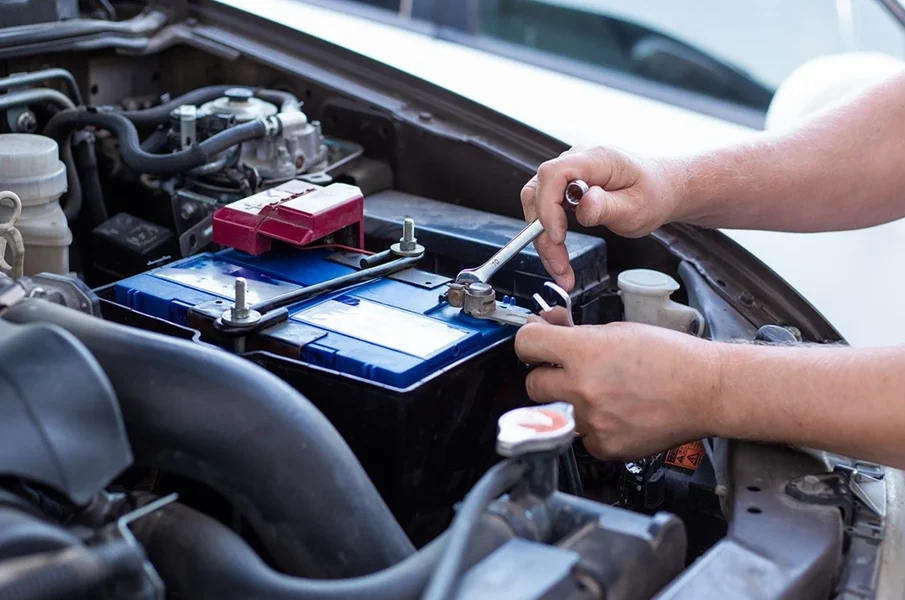
A visual check takes a minute and reveals a lot. White or bluish powdery deposits around the terminals indicate corrosion, which increases resistance and reduces the current reaching the starter. Cleaning them sometimes restores normal operation, but recurring corrosion suggests venting. A swollen or distorted casing means the battery has overheated internally and should be replaced without delay heat damage is not reversible. Any leakage, cracking or strong sulphurous smell is a clear failure signal.
Age Is a Factor in Itself
Batteries have a finite service life determined largely by heat. In consistently warm climates, chemical degradation runs faster and the practical lifespan is often shorter than the three to five years quoted in temperate markets two to three years is common. Most batteries carry a date code on the casing indicating when they were manufactured. If yours is beyond three years old and showing any of the symptoms above, the answer is not a diagnostic puzzle. Booking a car battery replacement proactively at that point costs the same as doing it after a failure, without the roadside element.
Driving Patterns That Shorten Life
How a car is used matters as much as its age. Short trips are the main culprit a journey of a few minutes draws heavily on the battery to start the engine and does not run long enough for the alternator to replace what was used. Repeated over months, the battery sits in a chronically undercharged state, which accelerates sulphation and permanently reduces capacity. Vehicles left standing for extended periods suffer the same way, since modern cars draw a small constant current for alarms, telematics and control modules. Frequent short journeys or long idle spells both warrant earlier replacement expectations.
Ruling Out the Alternator
Not every flat battery is a bad battery. If the alternator is not charging properly, a new battery will fail within days and the underlying fault remains. Signs pointing to the charging system include a battery warning light that stays illuminated while driving, headlights that dim and brighten with engine speed, and a battery that goes flat repeatedly despite being new. A proper diagnosis measures voltage at rest, during cranking and while running a healthy system typically shows around 12.6 volts at rest and roughly 13.8 to 14.4 volts with the engine running. Replacing the battery without that check risks paying twice.
Jump Starting Is Not a Repair
A jump start gets the engine running but resolves nothing. A battery that has been deeply discharged has usually sustained permanent capacity loss, and one that needed jumping once will need it again. Repeated jump starting also puts strain on the alternator, which was designed to maintain a charged battery rather than to recharge a flat one from scratch. Treat a jump start as a means of reaching a solution, not as the solution itself.
Replacing It Where the Car Sits
Because a failed battery leaves the vehicle immobile, taking it to a workshop is the one thing you cannot easily do. Onsite replacement resolves that directly a technician attends with the correct battery for the vehicle, removes the old unit, fits and secures the replacement, cleans the terminals and verifies charging output. On many modern cars the new battery must also be registered with the vehicle’s energy management system, which is a step that is easy to overlook and causes charging problems if skipped. Roadside providers typically cover batteries from the same vans that carry tyre equipment, so one call handles either failure.
Choosing the Right Replacement
Specification is not optional. The battery must match the physical size and terminal layout, meet or exceed the original cold cranking amps, and use the correct technology vehicles with stop-start systems require AGM or EFB batteries, and fitting a conventional battery in their place leads to early failure. Check the manufacturing date on the new unit too, since batteries deteriorate in storage. Ask about warranty terms and confirm the old battery will be taken away for proper recycling. Keeping a mobile tyre repair and battery provider’s number saved means the whole thing is a phone call rather than a problem.